Published: October 10, 2026
Category: Technology & India News
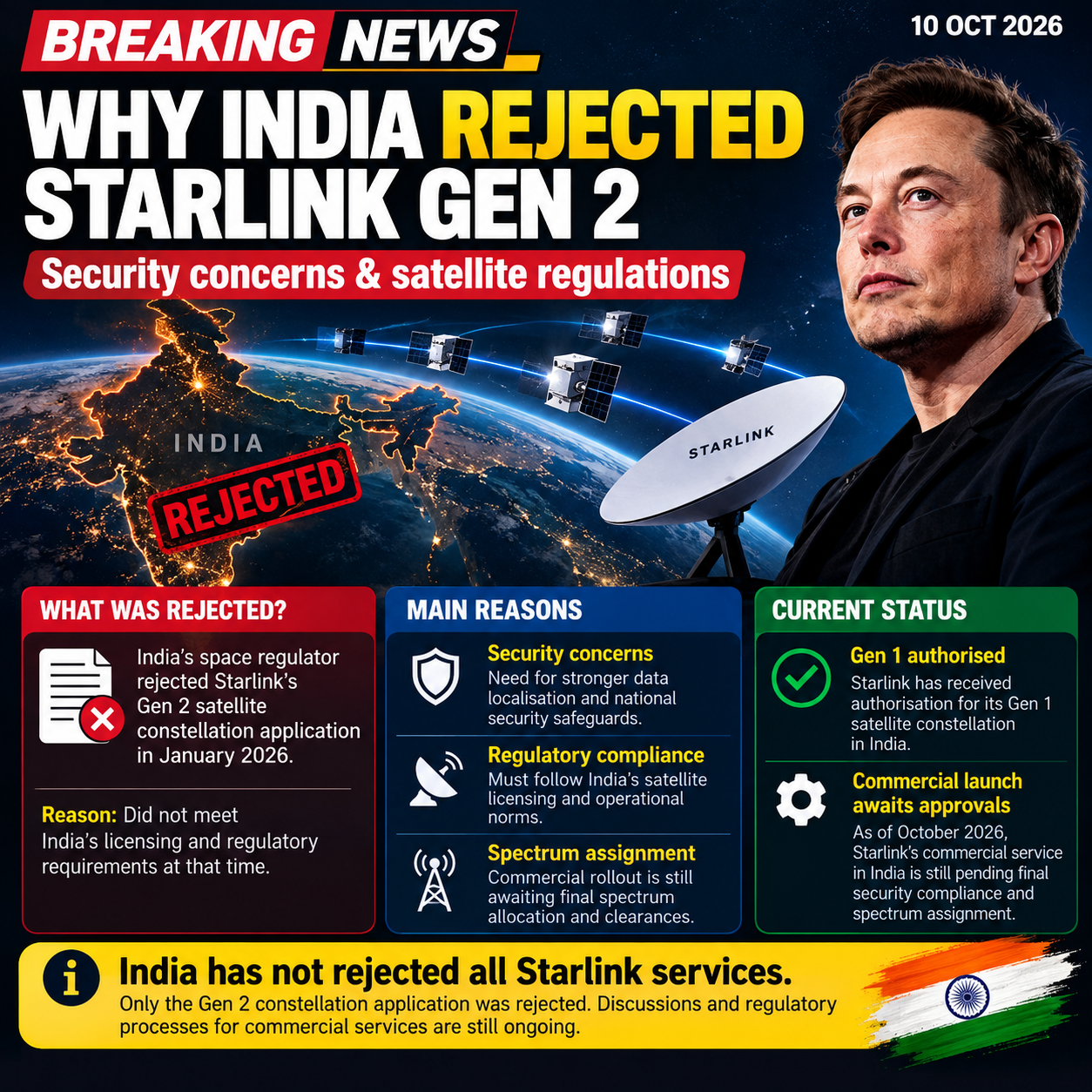
India’s satellite internet sector has attracted worldwide attention following reports that the country rejected an application linked to Elon Musk’s Starlink Gen 2 satellite constellation. The development has raised questions about national security, satellite internet regulations and the future of high-speed internet connectivity in India.
However, there is an important distinction: rejecting a Gen 2 application does not necessarily mean India has banned all Starlink services.
What Is Starlink?
Starlink is a satellite internet service developed by SpaceX, the aerospace company founded by Elon Musk. Instead of relying entirely on underground fibre-optic cables or conventional mobile towers, Starlink uses satellites in low Earth orbit to deliver internet connectivity.
The service aims to provide internet access in remote villages, mountainous regions, rural communities and other locations where conventional broadband infrastructure may be limited.
Starlink has attracted interest in India because satellite internet could help improve connectivity in geographically challenging areas.
Why Did India Reject Starlink Gen 2?
India’s reported rejection of Starlink’s Gen 2 satellite constellation application in January 2026 brought several regulatory issues into focus.
1. National security requirements
Satellite networks must comply with India’s security requirements. Authorities need appropriate safeguards for lawful interception, network monitoring and the prevention of unauthorised use.
The government must also consider how satellite communication systems could affect national security and critical infrastructure.
2. Satellite licensing and regulatory compliance
Satellite internet providers must obtain the necessary authorisations before offering services. These requirements can cover satellite operations, ground infrastructure, service conditions and compliance with Indian telecommunications rules.
An application that does not satisfy the applicable requirements may be rejected or require further review.
3. Spectrum allocation
Satellite internet services need access to suitable radio-frequency spectrum. The allocation and use of spectrum must follow India’s regulatory framework.
Spectrum policy is particularly important because satellite operators, telecommunications companies and other users need reliable rules to prevent interference and support the safe operation of networks.
4. Direct-to-mobile satellite technology
Next-generation satellite systems may offer connectivity directly to compatible mobile phones, depending on the technology and service configuration.
Such systems introduce additional questions involving interference, telecom licensing, emergency communications and coordination with existing mobile operators.
These issues require regulatory review before services can be deployed.
Has India Completely Banned Starlink?
No. The rejection of a particular satellite constellation application should not be confused with a blanket ban on every Starlink service.
India has separate regulatory processes for satellite constellation authorisation, telecommunications services and spectrum access.
Starlink’s ability to operate commercially in India depends on the specific authorisations and conditions applicable to its services.
Readers should check the latest announcements from India’s Department of Telecommunications and IN-SPACe for confirmation of the current approval status.
How Could Starlink Benefit India?
If authorised and commercially launched, satellite internet could offer several potential benefits.
Better rural connectivity: Remote villages may gain another option for accessing the internet.
Support during emergencies: Satellite networks could help restore connectivity when terrestrial infrastructure is damaged, subject to service availability and technical limitations.
Business opportunities: Remote businesses, tourism operators and industries could benefit from connectivity in areas with limited broadband access.
Education and healthcare: Schools, clinics and other institutions in underserved areas could gain improved access to online services.
However, the actual benefits would depend on coverage, equipment costs, service prices and the reliability of the connection.
What Challenges Could Starlink Face in India?
India is a highly competitive telecommunications market. Conventional broadband and mobile data services are already widely available in many urban and suburban locations.
Starlink may face several challenges:
- The upfront cost of satellite equipment.
- Monthly subscription prices compared with local broadband plans.
- Regulatory and security compliance requirements.
- Competition from existing telecom and internet providers.
- The need for reliable spectrum access and suitable ground infrastructure.
For many urban households, fibre broadband may remain a more economical option. Satellite internet could be particularly useful in locations where conventional connectivity is unreliable or unavailable.
What Happens Next?
The next steps depend on the regulatory status of Starlink’s applications, any revised submissions and the government’s decisions regarding spectrum and commercial services.
A rejection of a specific application does not automatically prevent a company from submitting a revised proposal, although approval is never guaranteed.
Consumers and businesses interested in Starlink should wait for official announcements about availability, pricing and authorised service plans in India.
Conclusion
India’s reported rejection of Starlink Gen 2 highlights the challenges of introducing next-generation satellite internet technology into a tightly regulated telecommunications market.
National security, spectrum management and licensing are central to the issue. At the same time, satellite internet could provide another connectivity option for remote and underserved areas.
The key takeaway: The Gen 2 application rejection should not be interpreted as a complete ban on Starlink. The company’s commercial prospects in India depend on the applicable regulatory approvals and official decisions.
Editorial note: Verify the January 2026 decision and the latest authorisation status against official government announcements before publication. Regulatory decisions and service availability can change.
Frequently Asked Questions
1. Who owns Starlink?
Starlink is a satellite internet service operated by SpaceX, founded by Elon Musk.
2. Why is Starlink Gen 2 facing regulatory hurdles in India?
The key issues include satellite authorisation, security requirements, spectrum access and compliance with Indian regulations.
3. Does the Gen 2 rejection mean Starlink is banned in India?
Not necessarily. A decision concerning one satellite constellation application is different from a blanket ban on all Starlink services.
4. Will Starlink be available across India?
Availability depends on the required approvals, technical coverage and the company’s commercial rollout.
5. Where can readers find official updates?
Check the websites of India’s Department of Telecommunications at dot.gov.in and IN-SPACe at isro.gov.in for relevant official information.
#starlink #elonmusk #india #news #viral
Leave a Reply